World War I
World War I, also known as the First World War, Great War and War to End All Wars, was a global military conflict which involved the majority of the world's great powers, organised into two opposing military alliances: the Entente Powers and the Central Powers.
The war started in 1914 with the assassination of Franz Ferdinand, which prompted Austria-Hungary to declare war on Serbia. Russia, Germany and France then entered the war, with Great Britain declaring war on Germany after an appeal from Belgium.
Explore the war records online or browse the CD collection.
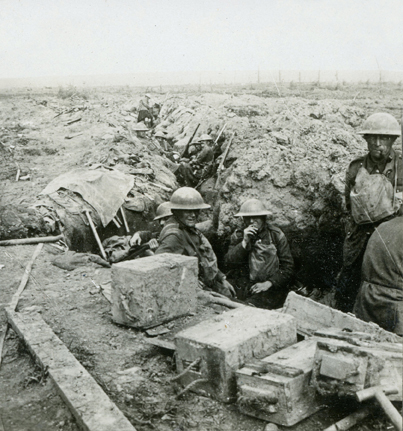
Scottish Soldiers Awaiting a Counter-Attack
A war of industrial scale
There were major weapon developments during the war, including the first large-scale use of chemical weapons by the German military when chlorine gas was used in Ypres, Belgium. The first tanks (called Mark I) were used by the British at the Battle of Flers-Courcelette. Flamethrowers were developed by the Germans, which enabled them to neutralise the enemy without destroying trenches (grenades would destroy soldiers and inflict structural damage on trenches).
Some war memorials date the end of the war as being when the Versailles treaty was signed in 1919; by contrast, most commemorations of the war's end concentrate on the armistice of 11 November 1918. Legally the last formal peace treaties were not signed until the Treaty of Lausanne.
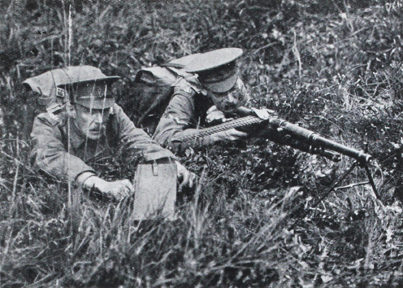
World War I gunners
The war brought rapid changes in military technology and reshaped the battlefields of Europe.
World War I timeline
From the opening crisis to the Armistice
The conflict begins
- Franz Ferdinand is assassinated
- Germany offers support to Austria
- Austria-Hungary declares war on Serbia
- Russia steps in to protect Serbia from attack
- Germany declares war on Russia and France
- Great Britain declares war on Germany after an appeal from Belgium
- The British Empire becomes involved in the war, which expands across the world
- The Battle of the Frontiers begins in France
The war spreads
- The first airship raid on England occurs
- The Second Battle of Ypres begins with the first German gas cloud attack
- The Allies suffer a crushing defeat in the Gallipoli Campaign
Attrition and major battles
- Britain introduces conscription after heavy losses on the Western Front
- The Battle of Verdun, the longest single battle of World War One, is fought
- The biggest naval battle, the Battle of Jutland, occurs
- The Battle of the Somme begins
The balance shifts
- German forces begin withdrawal to the Hindenburg Line
- The United States of America declares war on Germany
- An uprising in Russia forces Tsar Nicholas II to abdicate
The Armistice
- Germany manages to push the Allies back in Arras, but cannot sustain its attack
- The Allies carry out the Hundred Days Offensive
- An Armistice is signed, which ends the war on the Western Front